Does your car insurance policy cover gig work for companies like Uber, Instacart, Doordash, and beyond? Not sure? You’re not alone, as many gig workers simply do not know, including myself. In fact, I decided to write this article after a close call last week during an assignment for Wegolook.
Most personal policies do not cover many aspects of gig work. In many cases, you can add to your personal policy to cover gig work (great, another monthly expense). Some gig companies provide insurance during certain phases of work, which is helpful to an extent.
At any rate, the goal of this guide is to cover the following:
- When you’re covered
- When you’re exposed
- What extra insurance you actually need
- How each major gig app handles accidents
Section 1: Personal Insurance and Commercial Activity
Most personal auto insurance policies:
- Do not cover commercial use
- Can deny claims if you were “working” during an accident
- Can cancel your policy if they find out you were gig driving
What gig companies do:
- Offer partial coverage
- Only during specific phases of work
- Often with high deductibles
- Rarely cover your own car unless conditions are met
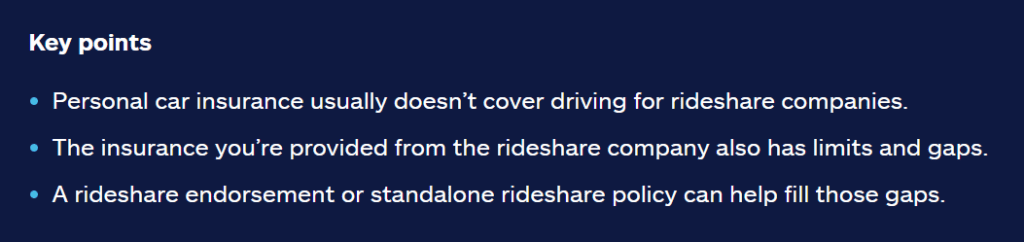
Below is a snippet from Allstate Insurance’s web site:
Section 2: The 3 Insurance Phases of Gig Work
Most delivery and rideshare apps break coverage into phases:
| Phase | What You’re Doing | Who Covers You |
|---|---|---|
| Phase 0 | App off | Your personal insurance |
| Phase 1 | App on, waiting for request | Usually limited company liability |
| Phase 2 | Accepted request, en route | Company insurance kicks in |
| Phase 3 | Passenger or food in car | Full company insurance (varies by app) |
Section 3: Uber Insurance Explained
Uber is one of the few companies that clearly publishes its coverage.
Uber Coverage by Phase
Phase 1 – App On, Waiting for Ride
- Liability only:
- $50,000 per person
- $100,000 per accident
- $25,000 property damage
Phase 2 & 3 – Ride Accepted or Passenger in Car
- $1 million liability coverage
- Uninsured/underinsured motorist coverage
- Collision & comprehensive only if:
- You already carry it on your personal policy
- You pay a $2,500 deductible
Key Uber Insurance Risks
- High deductible
- No coverage if app is off
- Your personal insurer may still deny claims
- Gaps when waiting for rides
Section 4: Instacart Insurance Explained
Instacart coverage is much thinner.
What Instacart Provides
- Liability coverage only
- Only while delivering or actively shopping
- No coverage for your car
- No coverage while waiting for orders
What Instacart Does NOT Cover
- Your vehicle damage
- Medical bills for you
- Accidents while logged in but idle
Instacart Overall
You should not rely on Instacart’s insurance. It’s bare minimum protection for third parties only.
Section 5: DoorDash Insurance Explained
DoorDash is similar to Instacart.
What DoorDash Covers
- Liability only
- Up to $1 million
- Only during active deliveries
What DoorDash Does NOT Cover
- Your car
- Waiting time
- Medical bills
- Uninsured motorist claims
DoorDash Overall
DoorDash insurance protects them, not you.
Section 6: Amazon Flex Insurance Explained
Amazon Flex offers more robust coverage than other platforms.
What Amazon Flex Covers
- $1 million liability
- Collision & comprehensive (with deductible)
- Only while delivering packages
Catches
- Deductible applies
- Doesn’t cover waiting for blocks
- May require proof your personal insurer denied the claim
Section 7: The Hidden Insurance Gaps
These are the moments most drivers get burned:
- App is on, waiting for orders
- Driving between hot zones
- Logged in but not on a job
- Just dropped off an order
- Driving home after finishing a shift
In most of these situations:
- ❌ Your gig app won’t cover you
- ❌ Your personal insurer may deny claims
- ❌ You pay 100% out of pocket
Section 8: What Insurance You Actually Need
Here are some options:
Option 1: Rideshare Endorsement (Best for Most People)
- Adds gig coverage to your personal policy
- Usually $15–$40/month
- Covers waiting time gaps
- Offered by: State Farm, Progressive, Allstate, GEICO
Option 2: Commercial Auto Policy (Overkill for Most)
- Full coverage for all gig work
- Expensive ($150–$400/month)
- More common for full-time drivers
Option 3: Risk It (Bad Idea)
- Hope nothing happens
- Lose coverage if insurer finds out
- Financial disaster if you crash
Section 9: Quick Comparison Table
| Company | Covers Waiting? | Covers Your Car? | Liability Limit | Deductible |
|---|---|---|---|---|
| Uber | Partial | Yes (active rides only) | $1M | $2,500 |
| Instacart | No | No | Varies | N/A |
| DoorDash | No | No | $1M | N/A |
| Amazon Flex | No | Yes | $1M | Varies |
| Lyft | Partial | Yes (active rides only) | $1M | $2,500 |
Section 10: FAQs
Do gig companies cover accidents while waiting for orders?
Usually no. Uber and Lyft provide limited liability only. Many food apps provide nothing. Coverage varies among the many platforms out there.
Will my personal insurance drop me for gig driving?
They can especially if you didn’t disclose it. It likely depends on some super-secret set of variables that us common folk aren’t privy to.
Is a rideshare endorsement worth it?
Yes, in terms of managing risk. Having said that, Side Hustle Watch understands that additional expenses are hard to handle as the cost of living continues to increase.
What happens if I lie about working during an accident?
Talk to a lawyer. Seriously, this could spell big trouble. Don’t lie. Better to be on the hook for money than for criminal charges. We can’t give legal advice, but this is trouble.
Section 11: Conclusion
If you’re using your car to make money, insurance companies categorize you under business or business-related coverage. Yes, you should make sure you have the right insurance, but we understand that those extra expenses add up.
Our next post on this topic will be how to get the best price on gig and commercial insurance. Good luck out there, and stay safe!